

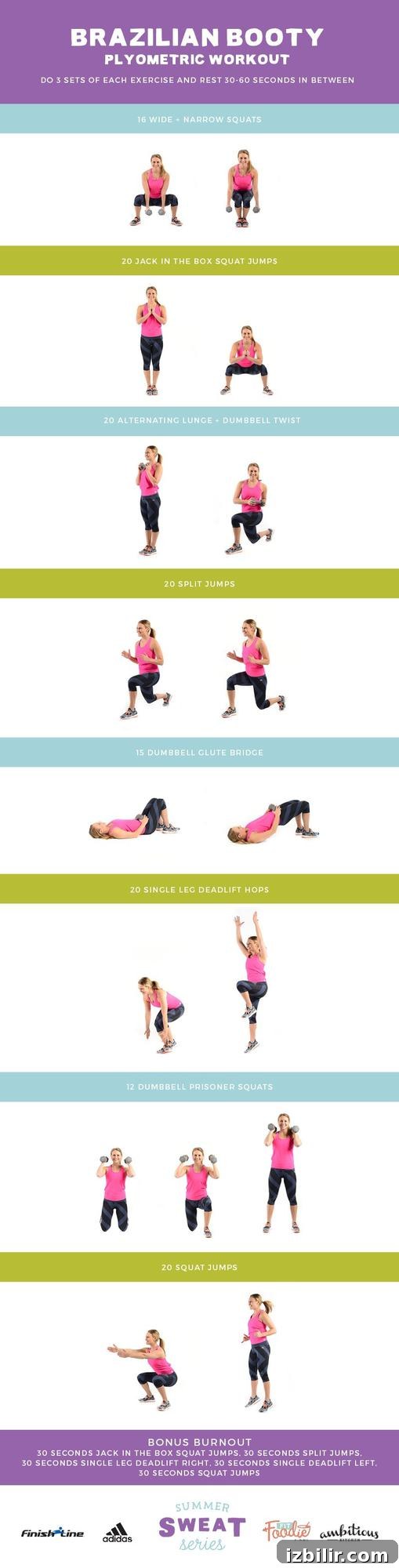
Brazilian Booty Plyometric Workout
Equipment needed: A pair of medium to heavy dumbbells (choose a weight that challenges you while allowing good form).
Warm-up: Begin with 5–10 minutes of light cardio (walking, jogging, jump rope) followed by dynamic mobility: high knees, butt kicks, jumping jacks, and air squats with arms reaching overhead. Warming up prepares your muscles and joints for explosive movements and reduces injury risk.
Description: Complete 3 sets of each exercise listed. Rest 30–60 seconds between exercises or longer if you need to catch your breath. Focus on controlled form and explosive intent on the plyometric elements.
Circuit
16 Wide + Narrow Squats
- Start standing with your feet together and a dumbbell in each hand at your sides.
- Lower into a narrow squat until your thighs are roughly parallel to the floor; keep weight in the heels and chest lifted.
- Stand up, squeeze the glutes, then take a large step to the right into a wide-stance squat with the dumbbells positioned between your legs.
- Stand and step back to the narrow stance. Continue alternating wide and narrow squats for the prescribed reps.
- Coaching cue: move smoothly between positions and keep the knees tracking over the toes.
16 Jack-in-the-Box Squat Jumps
- Stand with feet wider than shoulder-width. Lower to a squat and touch the floor lightly between your feet with your fingertips.
- Explode up, bringing your feet together and pressing your arms overhead.
- Land softly back into the wide squat and repeat. Maintain core engagement and a soft knee landing to protect your joints.
20 Alternating Lunge + Twist
- Stand tall with feet hip-width apart, holding one dumbbell with both hands at chest height (or one in each hand at your sides).
- Step forward into a lunge, keeping the front knee stacked over the ankle and torso upright.
- While in the lunge, rotate your upper body toward the front leg, then return to center and push back to standing.
- Alternate legs. This movement builds unilateral leg strength and adds rotational core engagement.
20 Split Jumps
- Start in a reverse lunge with your left foot back and right foot forward, both knees at about 90 degrees.
- Explode upward, switching leg positions midair so you land with the opposite leg forward.
- Continue alternating. Keep the torso upright, land softly, and control your knees to avoid inward collapse.
20 Dumbbell Glute Bridges
- Lie on your back with knees bent and feet shoulder-width apart. Place a dumbbell across your hips or hold it on your pelvis.
- Drive through your heels, lift your hips until your body forms a straight line from shoulders to knees, and squeeze the glutes at the top.
- Lower with control. Pause briefly at the top for maximal glute activation.
20 Single-Leg Deadlift Hops (10 per leg)
- Stand on one leg with a slight bend in the knee. Hinge at the hips to reach toward the ground, keeping a neutral spine.
- Lightly tap the floor with your fingertips if comfortable, then explode up into a small hop on the standing leg.
- Land softly and repeat. This improves balance, posterior chain strength, and single-leg power.
12 Dumbbell Prisoner Squats
- Stand with feet shoulder-width apart and dumbbells held at shoulder level.
- Lower into a controlled squat. From the bottom, drop one knee and then both knees to briefly rest in a kneeling position with weights still at the shoulders.
- Step up one foot at a time back to standing—this adds a mobility and stability challenge to the squat.
20 Squat Jumps
- Begin standing with feet shoulder-width apart.
- Lower into a squat, then drive through the heels and explode upward, swinging your arms to help generate height.
- Land softly and return immediately to a controlled squat for the next rep. Emphasize soft landings and steady breathing.
Bonus Burnout – Mini Circuit
- 30 seconds hopscotch squats
- 30 seconds Heisman bounds
- 30 seconds dumbbell swings
- 30 seconds lunge + squat jumps
Modifications and progressions: If you’re new to plyometrics, reduce jump height, perform split jumps or squat jumps without the explosive element, or lower the number of reps per set. To progress, increase dumbbell weight, add a fourth set, or shorten rest intervals. Always prioritize form over speed.
Disclaimer: Always consult your doctor before starting a new fitness program. While this workout was designed with expert input, you participate at your own risk. Modify exercises as needed, listen to your body, and stop if you experience pain beyond normal muscle fatigue.