

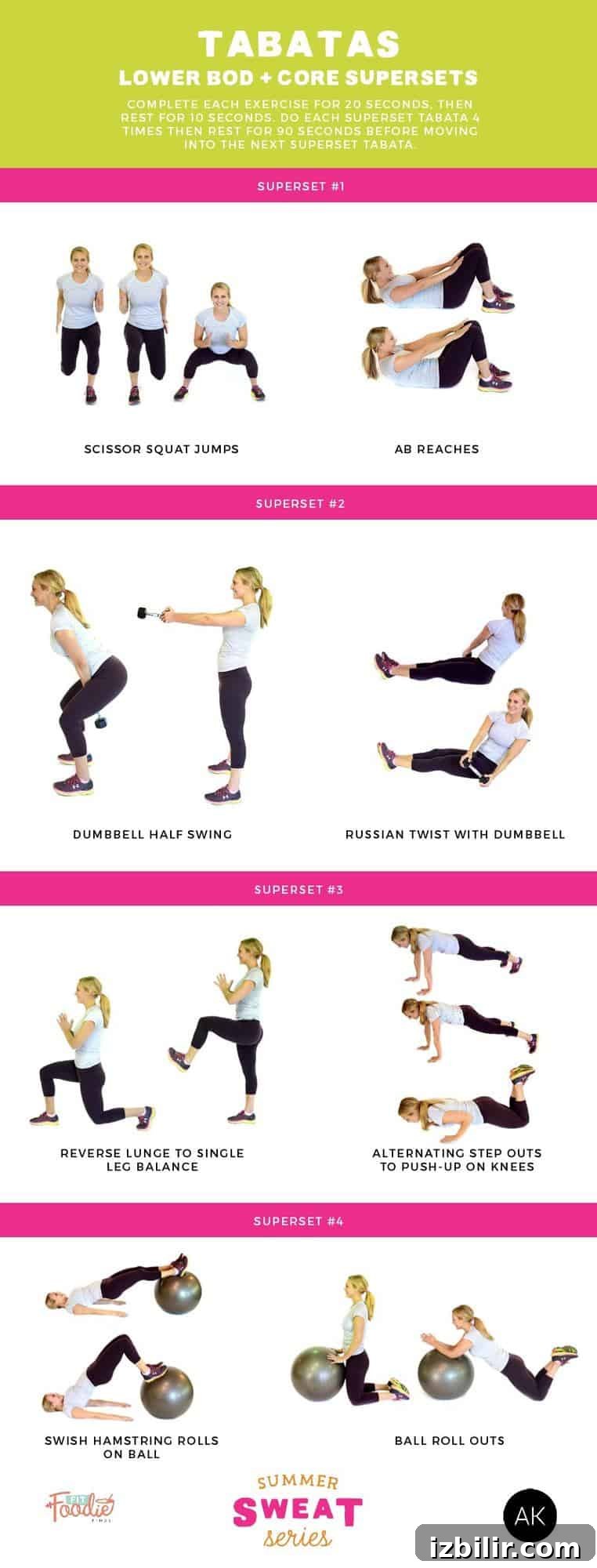
Tabatas – Lower Body + Core Supersets
Equipment needed: Heavy dumbbell and a physio ball (exercise stability ball).
Overview: This routine uses classic Tabata timing—20 seconds of high-intensity effort followed by 10 seconds of rest. Each superset pair is performed for four Tabata rounds (four minutes total). After completing a superset Tabata, rest for 90 seconds before moving to the next superset. The structure combines lower-body strength and dynamic core work to elevate your heart rate, build muscular endurance, and improve stability.
Warm-up: Begin with 5–10 minutes of light cardio (brisk walk, easy jog, or cycling) and follow with dynamic mobility: leg swings, hip circles, walking lunges, hip hinges, arm circles, and 1–2 minutes of core activation such as glute bridges and dead bugs. The goal is to increase blood flow and prime the hips, hamstrings, quads, and core for explosive movement.
Superset #1
Scissor Squat Jumps: Start with feet hip-width apart. Explode upward, landing with your left foot forward into a 90/90 lunge. Jump again, switching legs so the right foot lands forward in a 90/90 lunge. Jump once more and land in a squat with weight on the heels and feet hip-width apart. Continue this flowing pattern at a controlled but powerful pace. Modification: Remove the jump and perform alternating reverse lunges into a squat to reduce impact.
Ab Reaches: Lie on your back with feet flat, hip-width apart. Keep your shoulders lifted off the ground and hands resting on your thighs. On each exhale, reach hands toward your knees while engaging the entire core, then return to the start position with control. Maintain neck comfort by using the abs, not the hands, to lead the movement.
Superset #2
Dumbbell Half Swing: Stand with feet hip-width, holding a heavy dumbbell between your legs. Hinge at the hips with a slight knee bend—this is not a squat. Use hip drive to swing the weight up to about eye level with straight arms, then allow control as it descends back between the legs. Keep the back neutral; the power should come from the hips and glutes. Avoid hyperextending the spine at the top.
Russian Twist with Dumbbell: Sit with legs extended (or slightly bent for comfort), holding the dumbbell in front of you with straight arms. Rotate the torso to the right, engaging the obliques, then rotate to the left. Keep the chest lifted and the back flat. Exhale with each twist. Modification: Perform bodyweight twists without a dumbbell or keep feet on the floor for more stability.
Superset #3
Alternating Reverse Lunge to Single-Leg Balance: Stand tall and step back into a reverse lunge, keeping the front knee aligned over the ankle and the chest upright. Drive through the front leg and bring the back knee forward, lifting it toward the chest to balance on the front leg. Pause, reset to standing, and alternate sides. Focus on control and a steady balance hold. Progression: Hold light or moderate dumbbells to increase resistance.
Alternating Step-Outs to Knee Push-Up: Start in a high plank with shoulders over wrists and a neutral spine. Tap the right toe out to the side, then bring it back; tap the left toe out, then return. After a few step-outs, lower to the knees and perform a controlled push-up, leading with the chest and maintaining a straight line from head to knees. Progression: Perform full push-ups from the toes when ready.
Superset #4
Swiss Hamstring Rolls on Ball: Lie on your back with the physio ball under your calves and hips lifted so your body forms a straight line from shoulders to knees. Inhale, then roll the ball toward your glutes by bending the knees and pulling the ball in with your heels, raising the hips slightly. Exhale and extend the legs back out to the starting position. Focus on hamstring and glute engagement.
Ball Roll-Outs: Kneel with hands on the physio ball and core braced. Roll the ball forward until the body reaches a long, straight line, maintaining tension in the abs. Exhale and pull the ball back toward your knees to return to the start. Progression: Perform roll-outs from a tall-kneeling or toe-supported position. Modification: Hold a high plank instead of rolling if needed.
Challenge (Varsity): Repeat the entire circuit one more time for an extra challenge and extended conditioning.
Safety note: Always consult a healthcare professional before beginning a new exercise program. Modify movements to match your current fitness level and listen to your body. If you experience sharp pain, dizziness, or unusual symptoms, stop and seek guidance from a qualified professional. This routine is designed to be demanding—focus on form over speed for best results.
This Tabata-style superset workout efficiently targets the lower body and core while providing cardiovascular benefits. With clear progressions and modifications, the circuit is adaptable for a range of fitness levels—use heavier weights to build strength, increase speed for conditioning, or emphasize control for balance and stability.