
Ouch — that familiar soreness the day after leg day. If you’re feeling it, this at-home Tabata HIIT workout is exactly what you want: short, intense, and effective. It’s also gym-friendly if you prefer added resistance. The session targets the lower body while delivering cardio and high-intensity interval training that can boost fitness and metabolism in a time-efficient way.
High-intensity interval training (HIIT) alternates short bursts of maximal effort with brief recovery periods. These intervals raise heart rate quickly, then allow partial recovery before the next effort. The Tabata protocol is a popular HIIT format: 20 seconds of intense work followed by 10 seconds of rest, repeated for eight rounds to make a 4-minute block. You’ll follow five of these blocks for a total workout time of about 25 minutes.
The structure is simple, predictable, and motivating — you know exactly how long each hard effort lasts and when the rest comes. You don’t need equipment to make this work; however, progressions with dumbbells or plates are included if you want to increase intensity or train in the gym.
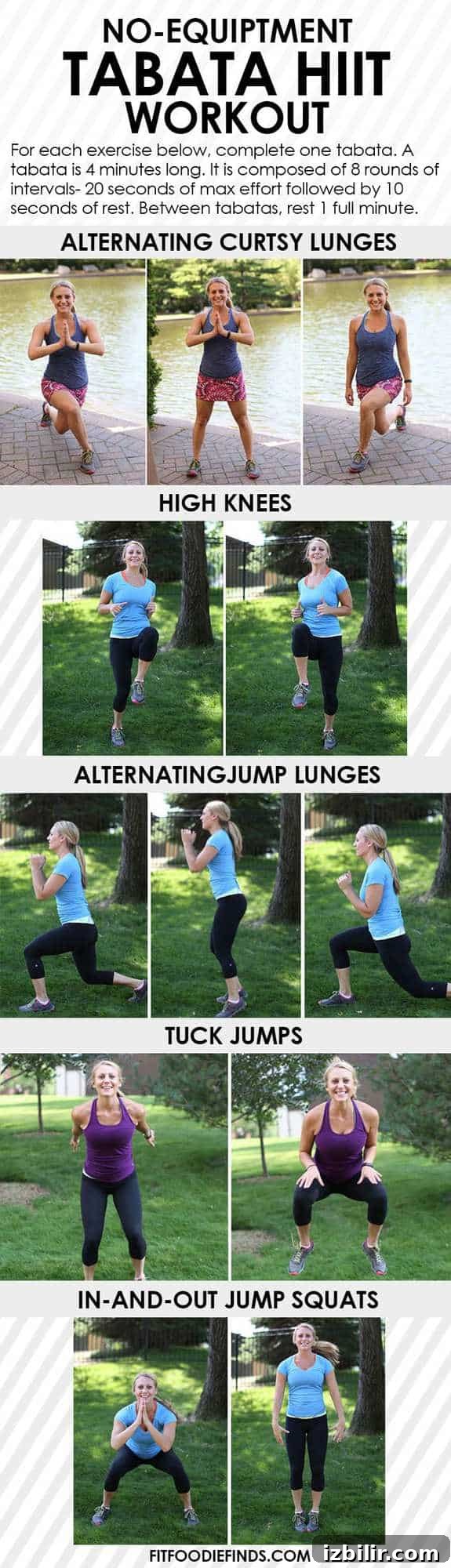
This workout contains five full Tabata rounds (each 4 minutes) for a roughly 25-minute session. Below are the exercises for each Tabata, with clear instructions, regressions for lower-impact options, and progressions if you want to challenge yourself.
Alternating Curtsy Lunge: Stand with feet hip-width apart. Step your right leg back and diagonally behind your left leg so the right foot lands to the left of the left leg. Lower into a lunge, then press through the front heel to return to standing. Alternate sides each repetition. Keep your chest lifted and back neutral.
- Regression: Do stationary curtsy lunges — perform all reps on one leg for the round, then switch the next round.
- Progression: Hold dumbbells and add an upright row as you stand to increase load and upper-body engagement.
High Knees: Start with feet hip-width apart. Run in place, driving knees up toward your chest with each step. Maintain an upright torso and engage your core for stability.
- Regression: Slow the movement and replace the plyometric action with a standing elbow-to-knee touch, adding a gentle twist for core engagement.
- Progression: Pump your arms overhead as you drive the knees up for extra intensity and shoulder activation.
Alternating Jump Lunges: Begin in a split stance. Lower into a 90/90 lunge keeping the front knee stacked over the ankle and chest lifted. Explode upward, switching legs mid-air so the opposite leg lands in front. Continue alternating with controlled landings.
- Regression: Perform stationary lunges, alternating legs by round rather than jumping.
- Progression: Hold a single dumbbell or plate (5–10 lb) at chest level or overhead to increase resistance.
Tuck Jumps: Start with feet hip-width apart. Jump up and pull your knees toward your chest, landing softly with knees slightly bent to absorb impact. Reset and repeat for each interval.
- Regression: Replace tuck jumps with butt kicks — a lower-impact option that still raises heart rate.
- Progression: After each tuck jump, sink immediately into a bodyweight squat before the next jump for added leg fatigue.
In-and-Out Jump Squats: Begin standing with feet hip-width apart. Lower into a squat keeping weight in the heels and chest proud. Explode upward, landing with feet together, then immediately jump feet back out to squat position and repeat. Focus on controlled, powerful rebounds.
- Regression: Perform regular bodyweight squats at a steady, controlled pace.
- Progression: Hold a dumbbell or weight plate (5–10 lb) at chest level to increase resistance.
Training tips and safety notes:
- Warm up for 5–10 minutes with dynamic movements (walking lunges, leg swings, light jogging, or mobility drills) to prepare joints and muscles.
- Maintain proper form throughout: keep knees aligned with toes, avoid collapsing through the hips, and land softly to protect joints.
- Adjust intensity based on your fitness level. Use regressions if you have knee, ankle, or other joint limitations, and progress only when your form remains solid.
- Focus on breathing: inhale during preparation, exhale during the exertion phase (the explosive movement), and use rest intervals to recover your breath.
- Finish with a brief cool-down and gentle stretches for the quads, hamstrings, calves, and hips to aid recovery.
Music and timing can boost motivation. If you prefer music, use any Tabata timer or a playlist that provides 20-second work and 10-second rest cues. Many fitness apps and music platforms offer Tabata-style tracks and timers to guide each interval.
This session is intentionally short and intense: five Tabata blocks deliver a concentrated dose of cardio and lower-body work in about 25 minutes, making it easy to fit into a busy day. Whether you’re training at home with no equipment or in the gym with added weights, the routine is scalable to your goals.
PS: If you take this workout to the gym, don’t be surprised if you look a little intense — headphones on, full effort — that’s the zone. Get it!