
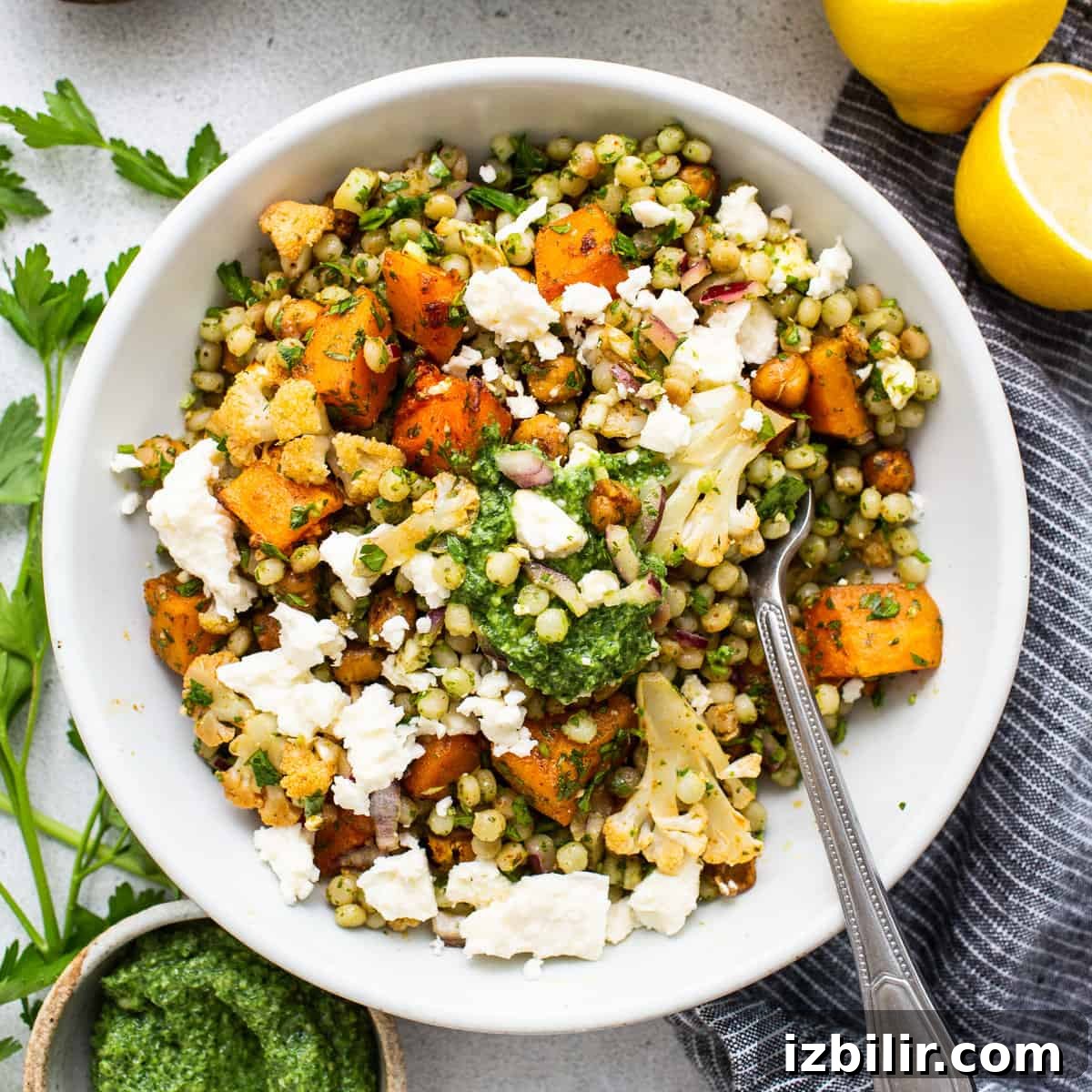
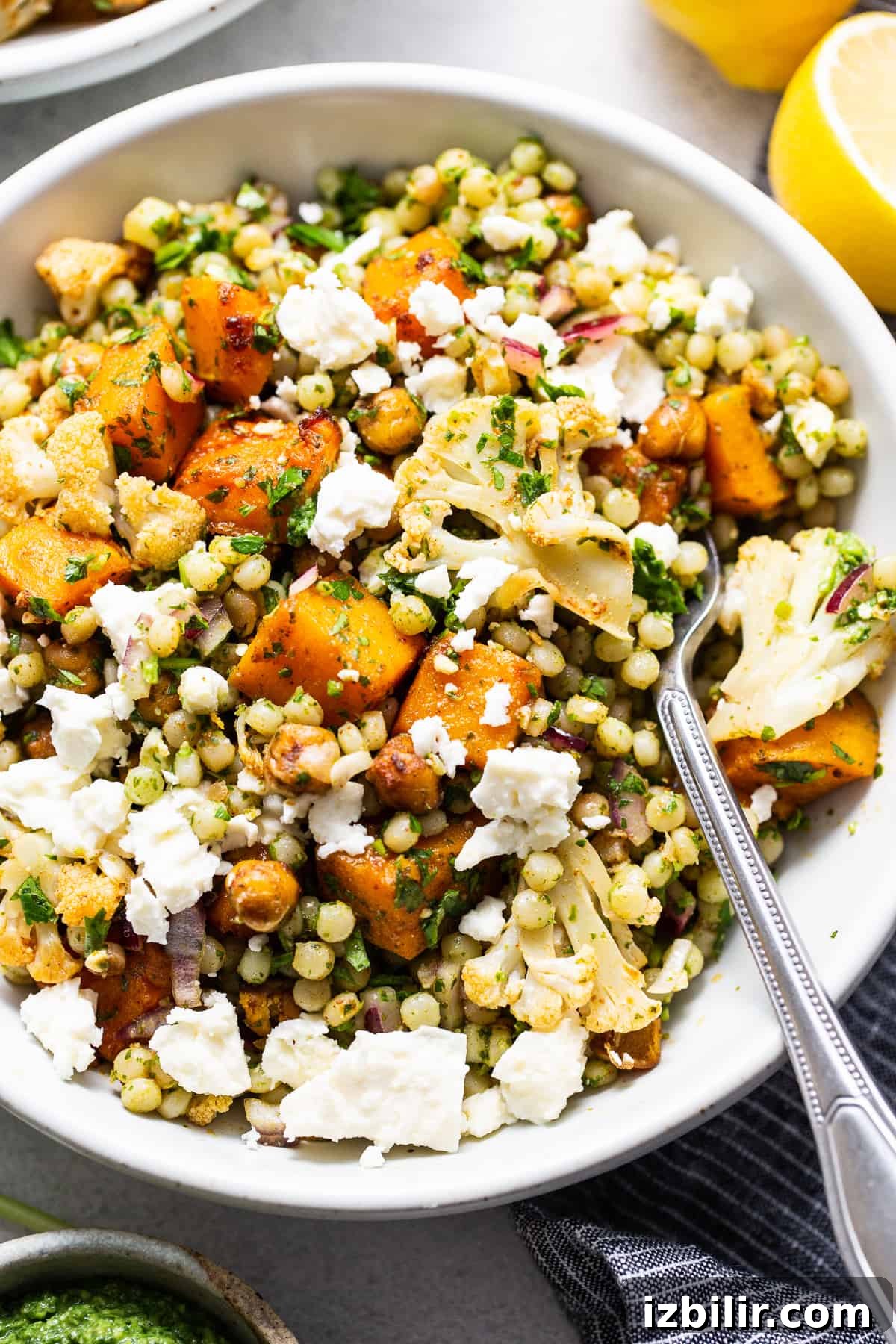
Say hello to a flavorful Israeli couscous salad that’s satisfying warm or chilled. This recipe combines toasted Israeli couscous with roasted vegetables, seasoned garbanzo beans, and a creamy kale pesto for a balanced, veggie-forward meal that delivers both texture and protein.
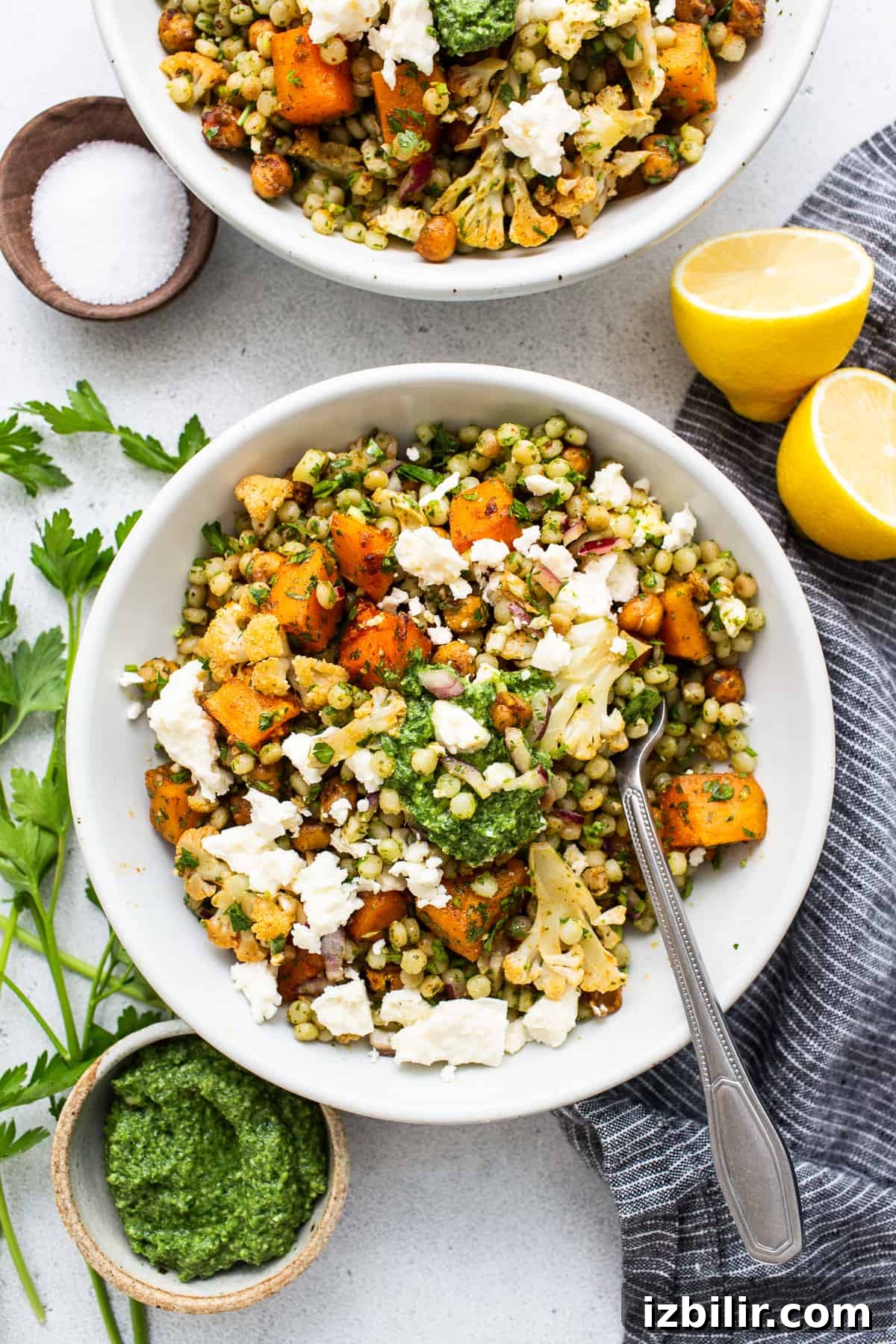
Israeli Couscous Salad
There’s no reason to serve dull salads when you can make this vibrant Israeli couscous salad. It’s hearty enough for dinner, convenient for weekly meal prep, and works beautifully as a side dish for a crowd.
Serve it warm right after assembling, or chill it and enjoy later—the flavors hold up well.
Why we love this salad
- Loaded with vegetables for color and nutrition.
- About 17 grams of protein per serving thanks to the chickpeas and cheese.
- Homemade kale pesto adds bright, savory depth.
- Israeli couscous offers a pleasant, chewy texture that feels satisfying without being heavy.
Featured Ingredients
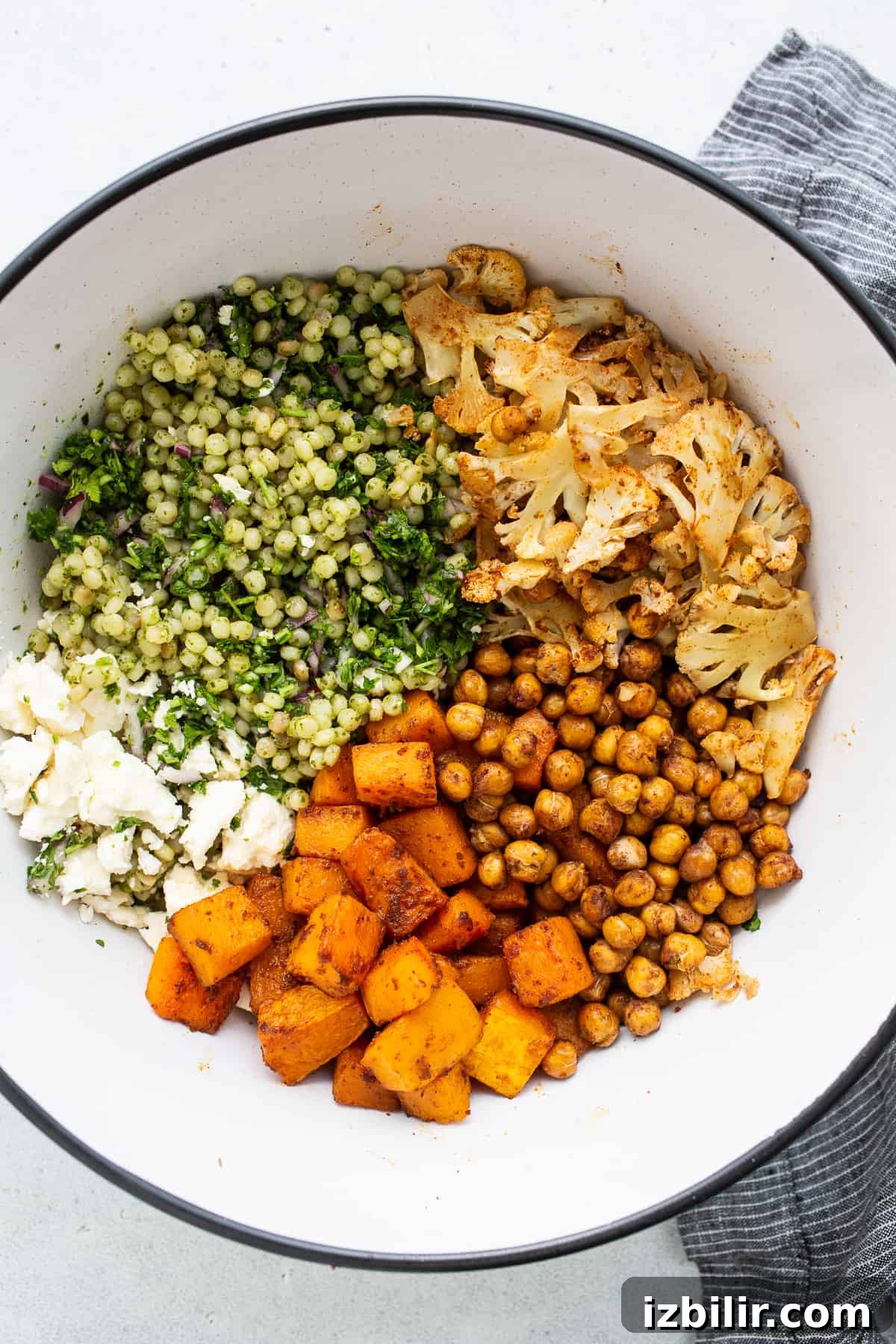
- Israeli couscous: Technically a small toasted pasta, not a grain. It toasts and cooks quickly, giving a pleasing bite.
- Kale pesto: Homemade kale pesto brings both greens and rich flavor. Store-bought pesto can be used if you’re short on time.
- Cauliflower: Thinly sliced cauliflower (a mandoline works well) adds a tender-crisp texture. If you don’t have a mandoline, a sharp knife is fine—slice into thin pieces.
- Garbanzo beans (chickpeas): Tossed in spices and roasted, they add crunch, protein, and savory-sweet notes.
- Butternut squash: Roasted cubes add natural sweetness and creaminess; sweet potato or carrots are easy substitutes.
The spice mixture for this salad combines garlic powder, chili powder, paprika, ground cumin, and coarse salt. These warm spices complement the roasted vegetables and kale pesto.
Easy
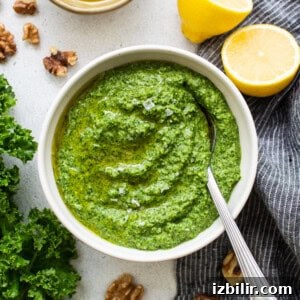
Homemade Kale Pesto
Make a batch of kale pesto to keep in the fridge for pasta, salads, or as a dip. It pairs especially well with toasted couscous.
Directions At a Glance
Scroll down to the recipe card for precise ingredient amounts and the full step-by-step instructions. The recipe is prepared in sections—pesto, couscous, roasted vegetables, and the cold salad components—so follow the order for best results.
- Prepare the kale pesto. Blend garlic, toasted garlic, kale, Parmesan, lemon juice, walnuts, salt, and olive oil until smooth and creamy. Set aside.
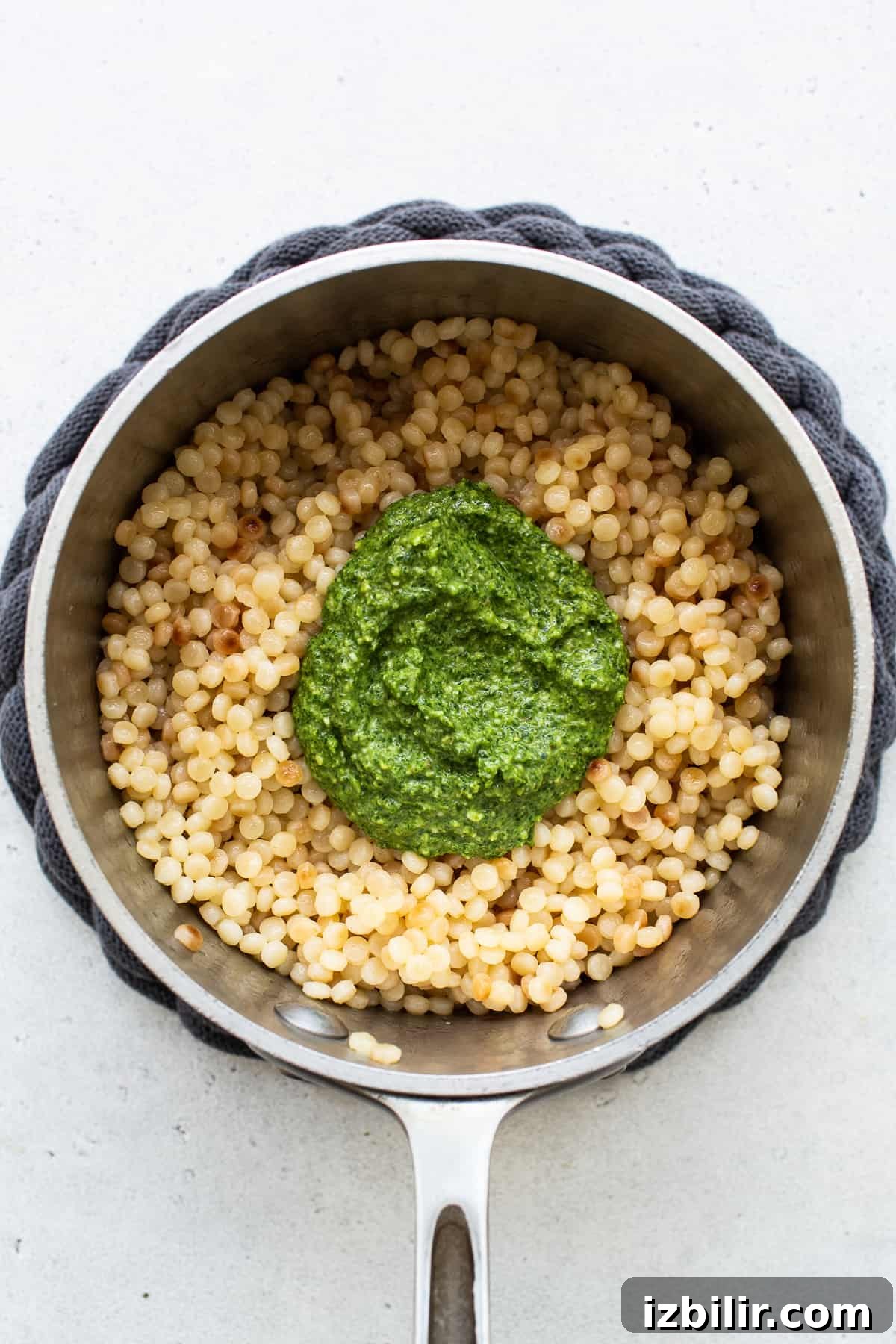
- Cook the couscous. Toast the couscous briefly in a little olive oil, then simmer in water until tender. Fluff and stir in the pesto so the grains are coated.
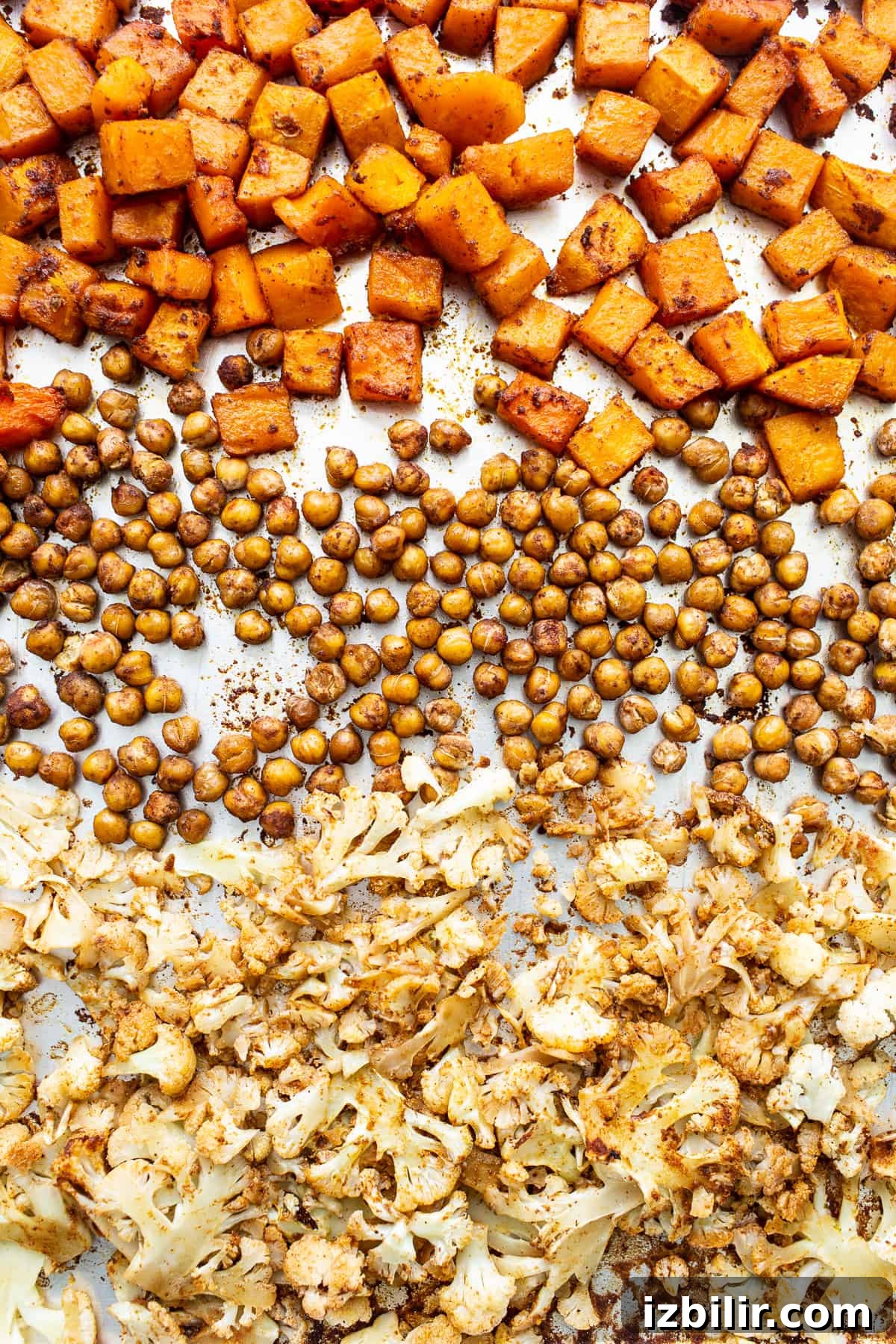
- Roast the vegetables and beans. Season and roast the butternut squash and spiced garbanzo beans first, then add thinly sliced cauliflower partway through so everything finishes together.
- Prepare the cold salad topping. Combine red onion, parsley, red wine vinegar, a pinch of salt, and crumbled feta for a bright topping to finish the warm mixture.
- Toss and serve. Combine roasted vegetables, couscous, and the cold salad mix. Serve immediately warm or chill for later.
Tips for this Couscous Salad
- Multiple steps can run at the same time—pesto, couscous, and roasting can overlap—so the salad is doable in about an hour.
- If you don’t own a mandoline, slice the cauliflower thinly with a sharp knife or roughly chop it; the salad still works well.
- Use store-bought pesto if you’d like to save time, but homemade pesto lifts the dish.
- Other root vegetables like sweet potato or carrots roast nicely if butternut squash isn’t available.
- This salad is delicious warm from the oven or served cold from the refrigerator—both work.
FAQ
Like all pasta-style ingredients, Israeli couscous is fine in moderation and makes a flexible base for vegetables and protein. Balance it with plenty of veggies and legumes.
Yes—Israeli couscous is a toasted pasta rather than a whole grain.
Orzo is the closest substitute by texture. You can also try quinoa, bulgur, or millet—prepare them according to their package instructions as cooking times differ.
Absolutely. Add any favorite vegetables, keeping in mind different roasting times so everything finishes evenly.
This salad can stand alone or be served with roasted or grilled proteins such as chicken, pork, steak, or salmon. It also pairs well with roasted tofu or additional beans for a vegetarian option.
Storage Suggestions
Allow the salad to cool completely, then store it in an airtight container in the refrigerator for up to 5 days. If chilling, add extra crumbled feta just before serving to preserve texture.
More of our favorite salads
Delicious Salad Recipes
- Farro Salad
- Mediterranean Couscous Salad
- Lemon Garlic Israeli Couscous with Whipped Feta
- Black Bean Couscous Salad
- Chickpea Couscous Salad
Israeli Couscous Salad — Recipe
Servings: 8 | Prep: 30 mins | Cook: 40 mins | Total: 1 hr 10 mins
Author: Linley Hanson
Ingredients
Kale Pesto
- 1/3 cup olive oil, divided
- 4 cloves garlic, peeled
- 4 cups chopped kale, stems removed and packed
- 1/2 cup grated Parmesan cheese
- 3 tablespoons fresh lemon juice
- 1/2 cup walnuts
- 1 teaspoon kosher salt
Israeli Couscous
- 1 tablespoon olive oil
- 1 1/2 cups uncooked Israeli couscous
- 2 cups water
- 3 1/2 tablespoons kale pesto
Spice Mix
- 1 tablespoon garlic powder
- 1 teaspoon chili powder
- 1 teaspoon paprika
- 1/2 teaspoon ground cumin
- 1 teaspoon coarse salt
Butternut Squash
- 4 cups butternut squash, cut into 3/4-inch cubes
- 1 tablespoon olive oil
- Half the spice mix (about 1.5 tablespoons)
Beans
- 15 oz canned garbanzo beans, drained and rinsed
- 1 teaspoon maple syrup
- 1/2 teaspoon ground cinnamon
- 1/2 teaspoon garlic powder
- 1/4 teaspoon salt
- 1/4 teaspoon cayenne pepper
Cauliflower
- 1 small head cauliflower (~4 cups), sliced thin
- 1 tablespoon olive oil
- Remaining half of the spice mix (~1.5 tablespoons)
Other Ingredients
- 1/2 large red onion, minced (~1/2 cup)
- 1 cup chopped fresh parsley
- 1 tablespoon red wine vinegar
- 1/4 teaspoon salt
- 1/2 cup crumbled feta
Instructions
- Make the kale pesto: Smash the garlic lightly and sauté 1 1/2 tablespoons olive oil with the garlic until fragrant and lightly golden. Add the cooked garlic to a food processor with kale, Parmesan, lemon juice, walnuts, salt, and the remaining olive oil. Pulse, then process on high until thick and creamy, scraping down the sides as needed. If the pesto is too dry, add another teaspoon or two of olive oil and continue processing. Set aside.
- Cook the couscous: In a small saucepan, heat 1 tablespoon olive oil over medium-high heat. Add the couscous and toast, stirring, until golden, about 3–4 minutes. Add 2 cups water and bring to a boil, then reduce heat to low, cover, and simmer 10–12 minutes or until the water is absorbed. Uncover, fluff with a fork, and stir in 3 1/2 tablespoons of the kale pesto until coated. Set aside.
- Prepare to roast: Preheat oven to 450°F (232°C). Line a baking sheet with parchment or grease with oil. Mix the spice blend in a small bowl.
- Season and roast squash: Toss butternut squash cubes with 1 tablespoon olive oil and half the spice mix (about 1.5 tablespoons). Spread on half of the baking sheet.
- Season the beans: In a bowl, combine garbanzo beans with maple syrup, cinnamon, garlic powder, salt, and cayenne. Spread the beans on the baking sheet alongside the squash. Roast for 15 minutes, tossing once.
- Prepare the cauliflower: While squash and beans roast, thinly slice the cauliflower (mandoline or sharp knife). Toss cauliflower with 1 tablespoon olive oil and the remaining spice mix.
- Finish roasting: After the first 15 minutes, add the cauliflower to the baking sheet and roast an additional 10–12 minutes, until cauliflower is golden and all vegetables are tender and warmed through.
- Make the cold salad mix: In a large bowl, combine minced red onion, chopped parsley, red wine vinegar, 1/4 teaspoon salt, and 1/2 cup crumbled feta. Toss to combine.
- Assemble the salad: When roasted vegetables and beans are done, add them to the bowl with the onion-parsley mixture and toss. Add the pesto-coated couscous and mix gently to combine. Taste and adjust seasoning; top with additional feta if desired. Serve warm or chill before serving.
Tips & Notes
- Steps can overlap: make the pesto, cook the couscous, and roast the vegetables simultaneously to save time.
- If you lack a mandoline, a sharp knife works—just slice cauliflower as thinly as you can.
- Store-bought pesto is a fine shortcut, though homemade adds freshness.
- Substitute other root vegetables like sweet potatoes or carrots for the squash if needed.
- Salad is written to be served warm but is equally enjoyable cold.
Nutrition (per serving, approximate)
Calories: 466 kcal • Carbohydrates: 59 g • Protein: 17 g • Fat: 28 g • Fiber: 11 g • Sugar: 7 g
Nutrition information is an estimate and should be used as a general guide.
Photography: Photos in this post were taken by Ashley McGlaughlin from The Edible Perspective.